
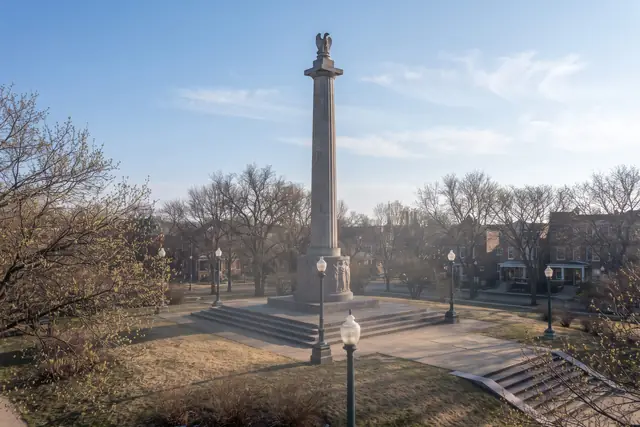
Chicago Community Area 22
Plumbing help in Logan Square
Greystones, brick two- and three-flats, boulevard mansions and new infill condos. In Logan Square the building usually shapes the plumbing problem.
Calls are answered by a referral service that connects you with a local plumbing provider. How this works
Buildings in Logan Square
Logan Square is one of Chicago’s 77 official community areas, on the Northwest Side. Its housing is dominated by early-20th-century two- and three-flats and greystones, with larger homes along the boulevards and newer condo buildings near transit. DePaul’s Institute for Housing Studies has identified Logan Square and neighboring Avondale as areas losing 2–4 unit buildings to conversions and redevelopment — so both original-plumbing buildings and gut-renovated ones are common.
| Building | Plumbing themes |
|---|---|
| Greystone / brick two-flat or three-flat | Shared stack and riser; garden unit backups; older galvanized supply; cast-iron stacks |
| Deconverted single-family (former 2-flat) | Mixed old and new piping; basement bathrooms often need ejector pumps |
| Boulevard single-family | Large older homes; long building sewers; mature parkway trees |
| Newer condo building | Association-managed shared systems; in-unit fixture issues |
Patterns, not a survey of individual buildings.
Common problems here
Garden-unit backups
Lowest fixtures in a shared building sewer — often the first to see storm backups. Basement flooding
Leaks between units
Stacked bathrooms mean an upstairs leak shows up downstairs. Two-flat guide
Low pressure upstairs
Older galvanized risers lose capacity with scale. Pipe materials
- Shared drain-waste-vent stack — a clog or crack affects every unit above it; older buildings often have cast iron.
- Shared water riser — corrosion and scale in older galvanized pipe can reduce pressure for all units.
- Garden/basement unit — lowest fixtures, so most exposed to backups.
- One building sewer serves the whole building.
Rules that apply
Logan Square is inside the City of Chicago, so City licensing and permits apply: plumbing contractors need a City of Chicago license in addition to State licensing, and sewer work needs a licensed drainlayer and a sewer permit. Many buildings here also have lead service lines — check the City’s inventory. Chicago permits · Lead lines
Frequently asked questions
Is Logan Square on combined sewers?
Chicago is generally served by combined sewers that carry rain and wastewater together. Ask the City (311) about conditions on your block.
Do I need City approval for plumbing work in my two-flat?
Most plumbing work in Chicago requires a licensed and bonded City plumbing contractor, and many jobs need a permit. Owners may do limited work themselves in their own building, but cannot hire an unlicensed person.
Sources
- DePaul Institute for Housing Studies — Characteristics of the 2 to 4 stock in Chicago neighborhoods Secondary
- City of Chicago — Does my project require a licensed plumbing contractor? Official / primary
- City of Chicago DOB — Sewer Permits Official / primary
- Grist / Inside Climate News — How we mapped Chicago’s lead pipes (Aug. 2025) Secondary
Information can change; official sources control.