
Guide · Chicago
Lead service lines in Chicago
The pipe that brings water from the street main into your building may be made of lead. Here is how to find out, which programs exist, and where a plumber fits in.
Calls are answered by a referral service that connects you with a local plumbing provider. How this works
~412,000
service lines known or suspected to contain lead
Source: Grist / Inside Climate News — How we mapped Chicago’s lead pipes (Aug. 2025). Of roughly 491,000 lines, per the City inventory submitted to Illinois EPA in April 2025
<4%
of those lines replaced in five years, as of October 2025
Source: WTTW News — Lead service line replacement progress (Oct. 24, 2025)
What a service line is
- Service line — material may be lead, galvanized, copper or other; check the City inventory.
- Curb stop / buffalo box — a valve typically in the parkway, operated by the utility.
- Inside shutoff valve — know where yours is before an emergency.
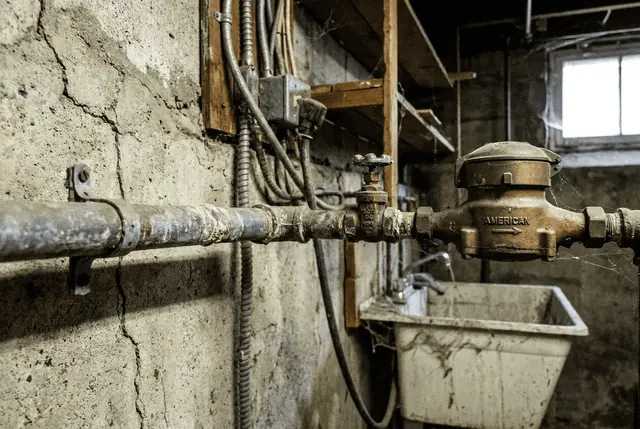
- Water meter. Where City and owner responsibilities split varies — confirm with your water utility (311 in Chicago).
How to check your line
- Look up your address in the City’s service line inventory (Department of Water Management).
- Find where the water line enters the building, before the meter. Note its color and whether it is soft and dull gray (a sign of lead) — let a professional confirm.
- Follow the City’s guidance on water testing.
Chicago’s Department of Water Management publishes a citywide service line inventory that residents can use to check the material of their line.
City programs
| Program | What it does | Notes |
|---|---|---|
| Breaks & Leaks | When a service line breaks or leaks, report it to 311; DWM has described replacing lead lines on both sides at no cost | Confirm current terms with 311 |
| Equity program | Free full replacement for income-qualified owners | Funding-limited; application required |
| Homeowner-initiated | Owner hires a licensed plumber; City waives certain permit fees | Waiver amount reported inconsistently — confirm with DWM |
Program details from news and City-derived reports; verify before relying on them.
State law
The Illinois Lead Service Line Replacement and Notification Act (Public Act 102-0613, effective January 1, 2022) requires water systems to inventory service lines and sets replacement timelines based on the number of lead lines, starting in 2027.
What we could not confirm
- Chicago’s final statutory replacement deadline — sources report different years; we do not state one.
- Current permit-fee waiver amount for homeowner-initiated replacements.
- Where responsibility for the service line splits between the City and the owner for your property — ask DWM / 311.
Check with the official source before relying on these points.
Where a plumber fits in
A licensed provider can help identify pipe material inside the building, replace interior plumbing, and — where the City program allows owner-hired work — perform a replacement under the required permits. Work on the public side is coordinated with the City.
Frequently asked questions
How do I find out if my Chicago home has a lead service line?
Check the City’s service line inventory through the Department of Water Management, and look at the pipe where it enters your basement before the meter. A plumber can help identify the material. The inventory classifies some lines as suspected rather than confirmed.
My service line is leaking. What should I do?
Call 311. Under the City’s program for breaks and leaks, the Department of Water Management has described replacing lead lines on both the public and private side at no cost when a service line breaks or leaks. Confirm current terms when you call.
Can a plumber replace just my side of the line?
Partial replacement can disturb lead and is handled under specific City and State rules. Ask the City and the provider before any work on a lead line.
Does a filter help?
Some filters are certified to reduce lead. Look for certification to the relevant NSF/ANSI standard for lead reduction and follow the City’s current guidance on water testing and filters.
Sources
- City of Chicago Department of Water Management Official / primary
- Grist / Inside Climate News — How we mapped Chicago’s lead pipes (Aug. 2025) Secondary
- WTTW News — Lead service line replacement progress (Oct. 24, 2025) Secondary
- IDPH — Lead service line replacements Official / primary
Information can change; official sources control.