
Guide
Backwater valve or overhead sewer? How to choose
Both protect a basement from sewer backups. Which one fits depends on how you use the basement, how the house is plumbed, and what your municipality supports.
Calls are answered by a referral service that connects you with a local plumbing provider. How this works
Questions that decide it
| Question | Leans toward a valve | Leans toward an overhead sewer |
|---|---|---|
| Do you need upper-floor drains during storms? | No — you can pause water use | Yes |
| Basement bathroom or kitchen? | Few or none | Yes, several fixtures |
| Comfort with a pump and power dependence? | Prefer no power needed | Fine with a pump and backup |
| Municipal program? | Program covers valves | Program covers overhead sewers |
Living with a backwater valve
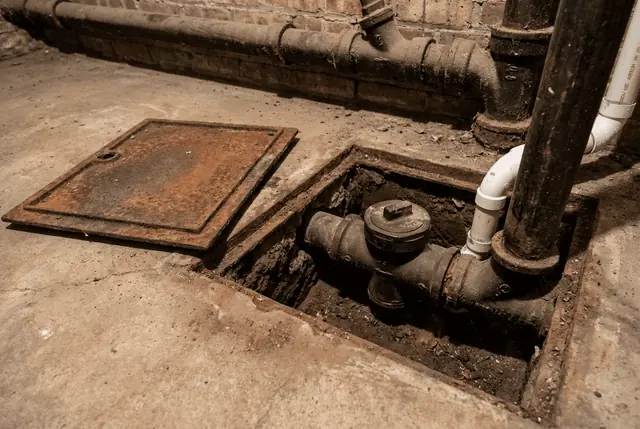
- Basement floor drain — the lowest opening, so usually the first place sewer water appears.
- Private sewer lateral (building sewer) — typically the owner’s responsibility.
- Backwater valve — a flap that is meant to close when flow reverses; needs an access cover for cleaning and inspection.
- Combined street sewer — during heavy rain it can fill and back up toward buildings (MWRD).
- When it is closed during a surcharge, water you use inside has nowhere to go — avoid running water during heavy storms.
- Keep the access cover clear; clean and inspect per the manufacturer.
Living with an overhead sewer
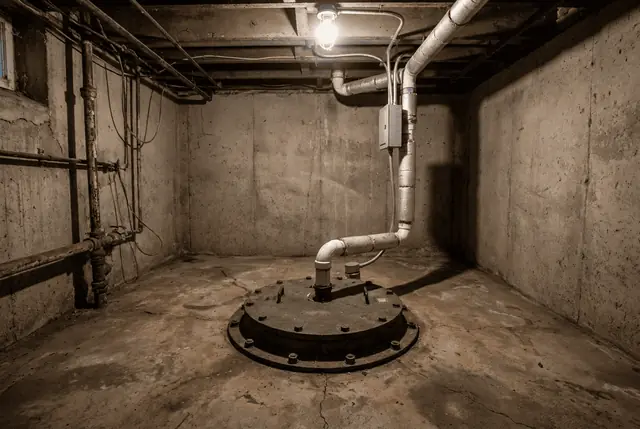
- Ejector pump with check valve lifts basement wastewater up; it needs power, so outages matter.
- Overhead sewer line runs near the basement ceiling.
- Building sewer exits the wall at a higher elevation.
- Former floor-level openings are sealed under the design.
- The ejector needs power; consider backup power or avoid basement fixtures during outages.
- Test the pump and alarm periodically.
Local programs
See the comparison of municipal programs on backwater valves & overhead sewers — Oak Park, Schaumburg, Elmhurst, Joliet and Des Plaines are covered.
What to ask a provider
- Will you camera-inspect the building sewer first?
- Which fixtures will be protected, and which will not?
- Who pulls the permit, and does the design meet program rules?
- What maintenance does it need, and how will I access it?
Frequently asked questions
Can I install both?
Some designs combine an overhead sewer with a check valve. A provider can explain what fits your house and code.
Does either stop groundwater?
No. Groundwater is handled by drain tile and a sump pump.
Related
- Backwater valves & overhead sewersService and programs
- Sewer backupWhat to do
- Basement water guideSewer or groundwater?
- Bungalow plumbingFloor drains
Sources
- Metropolitan Water Reclamation District — Understanding Your Sewer Official / primary
- City of Chicago DOB — Blocking Rainwater and Preventing Sewer Backup Official / primary
Information can change; official sources control.