
Service · Elmhurst
Overhead sewers in Elmhurst
Elmhurst shares the cost of overhead sewers — but the program also requires separating stormwater from the sanitary sewer, which shapes the whole project.
Calls are answered by a referral service that connects you with a local plumbing provider. How this works
Elmhurst’s overhead sewer program
Elmhurst’s 2023 Overhead Sewer Program provides 50% city cost sharing of eligible costs up to $5,000. It requires that perimeter drain tile and other stormwater sources be disconnected from the sanitary sewer, and that a sump pit and sump pump be installed.
Source: City of Elmhurst — Overhead Sewer Program (2023 PDF)
Two systems in one project
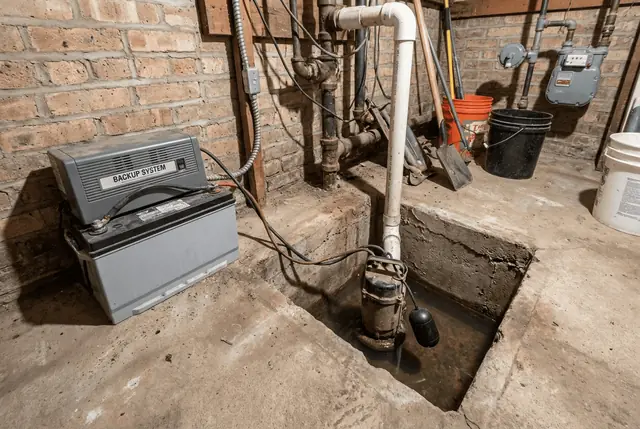
An Elmhurst conversion usually means an ejector for basement wastewater and a sump pump for groundwater from the drain tile. They are separate pits and separate discharges.
- Ejector pump with check valve lifts basement wastewater up; it needs power, so outages matter.
- Overhead sewer line runs near the basement ceiling.
- Building sewer exits the wall at a higher elevation.
- Former floor-level openings are sealed under the design.
- Drain tile collects groundwater around the foundation.
- Primary pump runs on household power.
- Battery backup pump can run during an outage, for a limited time.
- Check valve keeps discharged water from falling back into the pit.
- Discharge outlet — local rules may say where it can discharge.
Planning questions
- Where will the sump discharge outside?
- Do downspouts or other storm connections go to the sanitary sewer now?
- Is backup power planned for both pumps?
- What happens to finished basement areas?
Before you start
What we could not confirm
- Whether the cap is still $5,000 (2023 document).
- Elmhurst permit fees and pre-approval steps.
Check with the official source before relying on these points.
What affects the cost
We do not publish prices. Providers typically consider ejector and sump installation, drain tile disconnection, floor work, electrical, backup power, permits and restoration. Ask how the price is calculated before work starts.
Frequently asked questions
Why does Elmhurst require a sump pump for an overhead sewer?
The program requires drain tile and other stormwater to be disconnected from the sanitary sewer; that groundwater then needs a sump pump to leave the house.
Is this the same as Schaumburg’s program?
Both share 50% up to $5,000 as published, but the rules differ — Elmhurst’s 2023 document adds stormwater-separation requirements. Check each city’s current terms.
Related
- Elmhurst plumbing helpHomes and permits
- Schaumburg overhead sewersCompare
- Sump pump repairSecond system
- Backwater valves & overhead sewersCompare options
Sources
- City of Elmhurst — Cost-Sharing Programs Official / primary
- City of Elmhurst — Overhead Sewer Program (2023 PDF) Official / primary
Information can change; official sources control.